
Menu
Springfield Commercial Concrete: Flatwork Installation Tips
Commercial Concrete Springfield
Massachusetts’ weather conditions create a difficult environment to install quality commercial concrete due to freezing and thawing; therefore, it is essential to have an experienced contractor with the correct techniques and equipment to provide a high-quality, durable, and attractive solution for your business. A good commercial concrete installer will also take into consideration the local soil conditions and applicable building codes so that your flatwork will last as long as possible. Investing in high-quality flatwork will increase the value of your business and continue to operate for years without maintenance or repairs.
Commercial Concrete Fundamentals
Industrial-grade concrete far surpass those for residential applications by increasing strength ratings and adding specialized additives to meet the demands of heavy-duty applications. Typical PSI ratings for commercial flatwork can range from 4000 to 6000 pounds per square inch, and are dependent upon the intended use of the concrete as well as the expected traffic volumes anticipated. Fibers added to the concrete will help to prevent cracking, while steel reinforcement will add to the structural integrity to withstand the weight of the heavy equipment being used.
Adequate design of the concrete mixture should include air entrainment to meet the freeze-thaw requirements for Massachusetts and the harsh winters found in New England. The quality of the aggregates selected for the concrete mixture will also affect the overall performance of the finished product, in addition to minimizing maintenance requirements over its extended service life. Proper installation techniques will enhance the performance of the finished material by providing precise placement and finishing techniques.
Applications in Springfield
Warehouses located near major highways and transportation corridors require special concrete flooring that will be able to endure heavy traffic from forklifts and other types of storage equipment. Super-flat concrete specifications are ideal for distribution centers because they allow for efficient operation of automated systems. Plants that manufacture products require chemical-resistant surfaces that will remain structurally sound even when exposed to various industrial processes.
Decorative techniques can be employed on retail store floors to create durable, attractive surfaces that will be pleasing to customers. Floors for office buildings require smooth, even surfaces that will accommodate furniture placement while also appearing professionally maintained. Seamless installations are necessary for medical facilities so that they may be cleaned and sanitized.
Installation Techniques for Flat Work
Installation of commercial concrete flat work begins with complete site preparation, including soil testing and verifying the grade to ensure the best possible base conditions for the installation. Grading is performed using laser-guided grading equipment to accurately establish elevation requirements for proper drainage and equipment operation. A vapor barrier is installed to prevent moisture migration, which may cause loss of adhesion and compromise the integrity of the surface.
The strategic placement of joints in commercial concrete flat work is critical to accommodate thermal expansion while maintaining structural continuity over large installation areas. Control joints are placed using saw-cutting techniques to direct cracking along predetermined lines rather than allowing it to occur randomly. Isolation joints are used to isolate different sections of concrete to prevent damage caused by differential movement.
Placement Techniques
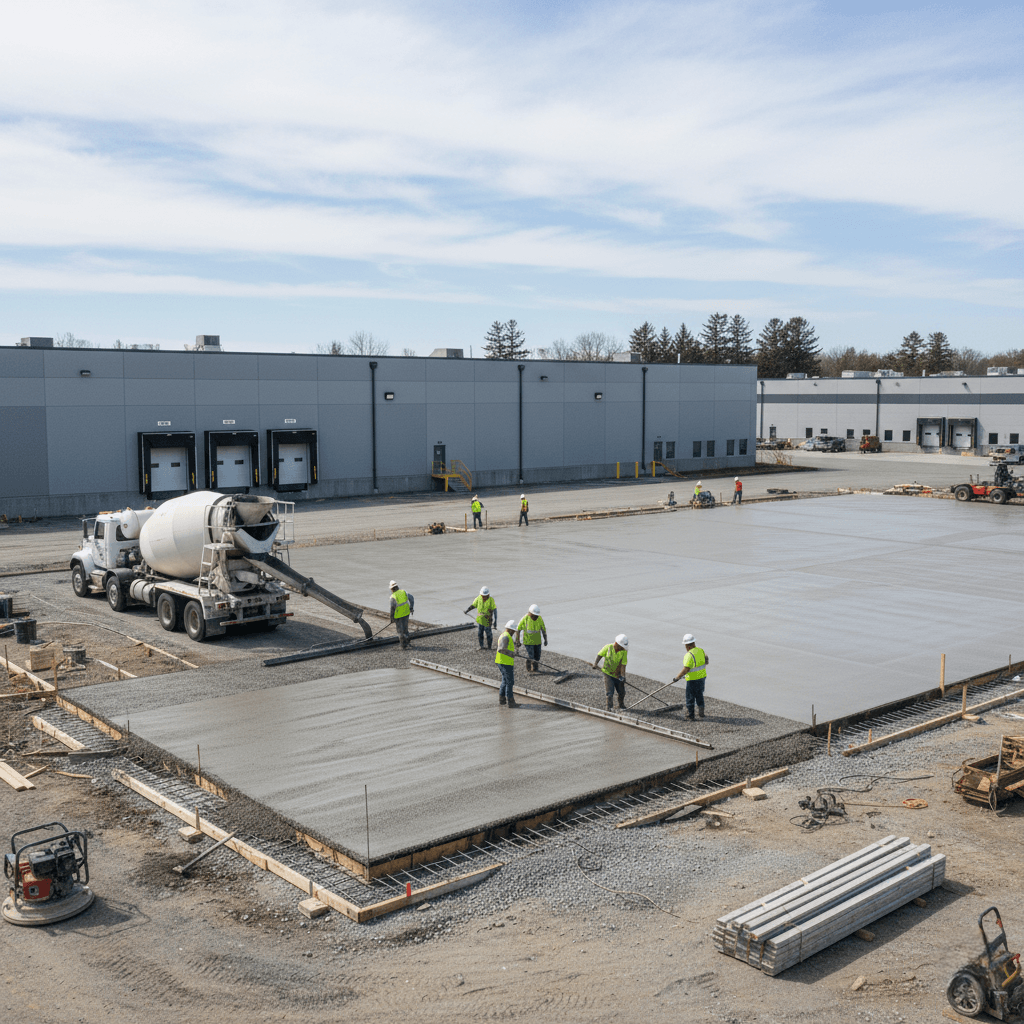
Concrete pumping systems are used to place concrete in areas that are inaccessible to conventional delivery vehicles while maintaining the consistent quality of the mix. Boom pumps are used to reach elevated locations and confined spaces common in industrial construction projects. Line pumps are used for precise control in placing concrete in areas where detailed placement requirements exist around equipment and infrastructure.
Power screeding equipment is used to achieve uniform surface elevations over large areas while consolidating the concrete for maximum density. Laser-guided screeds are used to precisely measure elevation requirements to ensure that the correct elevations are established for equipment installation and operational requirements. Verification of thickness and grade requirements is completed throughout the installation process to ensure compliance with specifications.
Finishing Standards
Finishing of commercial concrete requires specialized techniques to satisfy both the functional and durability aspects of demanding operational conditions. The float finishing technique is used to produce surfaces that are extremely dense and resistant to wear, yet contain enough texture to meet safety requirements. The trowel finishing technique is used to produce smooth surfaces that are ideal for installing equipment and for material handling operations.
Automated warehouse systems require superflat specifications that have very tight floor tolerances to operate properly. Industry standards require that the floor be level and flat. Professional finishing crews utilize specialized equipment to achieve these very stringent tolerance requirements.
Coating Systems for Industrial Use
Epoxy coating systems are available to provide chemical resistance and increased durability for manufacturing and processing facilities. Urethane coating systems provide superior abrasion resistance for areas that receive high traffic and are subjected to heavy equipment usage. Polyaspartic coating systems cure rapidly to minimize downtime for installation projects.
Anti-slip additives are applied to improve safety in areas prone to moisture and/or chemical spills common to industrial settings. Color-coding systems can be used to define traffic lanes and safety zones in large facilities. Professional application of coating systems ensures optimal adhesion and performance of the system in the most demanding of environments.
Cost Considerations in the Springfield Area
Commercial concrete in Massachusetts can range from $10 to $15 per square foot for standard industrial flat work, including all materials and professional installation. Decorative finishes and specialized applications requiring higher specification levels can cost between $20 and $30 per square foot, based on the complexity of the project. Site-specific factors such as soil conditions, accessibility, and preparation requirements can significantly impact pricing.
The size of the project can also have an effect on unit pricing, as larger projects can take advantage of equipment-mobilization efficiencies and material purchasing advantages. Projects with a total square footage of 50,000 or more can realize significant savings in terms of unit pricing due to economies of scale. Project timing can also play a role in coordinating with other construction activities to optimize the efficiency of the project while limiting overall project costs.
Opportunities for Value Engineering
Business operations can continue while the installation occurs by implementing strategic phased construction to spread the costs associated with the installation over multiple budget periods. Alternate reinforcement options can be implemented to meet the performance requirements of specific applications while controlling costs. Optimizing the selection of materials can meet performance requirements while eliminating unnecessary premium specifications.
When evaluating the long-term cost of an installation, consideration must be given to the maintenance requirements and lifecycle costs of the installation. Quality installations will always prove to be less expensive in the long run than low-cost alternatives. Energy efficiency benefits of concrete as a thermal mass can also result in reduced operating costs in climate-controlled facilities. Consultation with professionals will help identify cost-effective solutions that meet performance requirements and fit within budgetary constraints.
Protocols for Quality Control
Comprehensive testing programs must be implemented to ensure the concrete meets the designated strength and durability requirements through systematic sampling and laboratory analysis. Testing for slump during placement will ensure the proper consistency of the mix. Air content testing will confirm if the proper amount of air has been entrained to provide freeze-thaw resistance in accordance with Massachusetts requirements. Laboratory testing of compressive strength will validate the strength developed in the finished concrete.
Verification of the surface quality of the finished product will be accomplished utilizing precise measuring tools to determine whether the flatness and levelness tolerances are acceptable for equipment operation. Prior to applying any protective coating to the finished product, the moisture content of the surface will be tested to prevent premature application that may compromise the adhesion and long-term performance of the coating. Documentation of all testing and inspections will serve as evidence for warranty coverage and for quality assurance purposes.
Monitoring Performance
Inspections at regular intervals will identify any issues prior to them developing into costly repairs that will disrupt business operations. Movement tracking systems can monitor crack patterns to determine if the structure is performing as expected or if environmental influences are causing the cracks. Professional evaluations will provide recommendations for preventive maintenance to increase the service life of the installation.
Temperature monitoring during the curing period of the installation will prevent temperature-related stresses that may compromise the ultimate strength of the finished product. Moisture management systems will prevent the collection of water on the surface of the installation, which will ultimately undermine the surface integrity of the installation over time. Documentation of performance will be tracked to support warranty claims and future planning decisions.
Compliance Requirements in Springfield
Building codes in Massachusetts require specific standards for the installation of commercial concrete, including strength requirements and inspection requirements. The Department of Inspectional Services for the City of Springfield is responsible for enforcing compliance with these codes through routine review and field inspections. Contractors who install commercial concrete must be certified to ensure that they comply with changing regulatory requirements.
Environmental regulations regarding stormwater management and waste disposal are relevant to the planning and execution of commercial construction projects. OSHA regulations must be complied with regarding protecting workers during the placement and finishing of concrete. ADA compliance regulations require that accessibility features meet federal standards for public accommodations.
Process of Obtaining Permits and Conducting Inspections in Springfield
Permits for commercial buildings require detailed drawings of the proposed installation to include specifications for the concrete, reinforcement details, and environmental factors. Professional reviews of these plans will ensure compliance with building codes and identify potential problems prior to commencing construction. Scheduling inspections in conjunction with the placement of concrete will ensure that inspections are conducted in a timely manner to avoid delaying the curing of the concrete.
Depending on the location of the project, additional permits may be required if the project impacts traffic or requires utilities to be relocated adjacent to major thoroughfares such as Interstate 91 or Route 20. Professional contractors are experienced in navigating regulatory requirements while maintaining project timelines. Compliance documentation is essential to obtain final approval and occupancy permits necessary to begin business operations.
Springfield Concrete Masters provides extensive experience in commercial concrete and flat work installations in the Springfield area. Our team of professionals specializes in achieving exceptional results for our clients’ warehouse, retail facility, and industrial construction projects while meeting the most demanding schedules and quality standards to ensure successful business operations.
LATEST POSTS